




Selecting components for a new power tool line is one of the highest-stakes decisions an OEM brand owner makes, because the supplier you choose defines the warranty cost, the lead time, and the failure mode your end user will eventually experience. After supporting brand owners across more than 60 OEM projects in the past three years, I have learned that the question is rarely “who can produce this part cheapest”; it is “who can absorb my volume curve, protect my IP, and ship a consistent part across the next five years.”
TL;DR — Key Takeaways for OEM Brand Owners
- Component choice is a five-year decision, not a purchase-order decision, so evaluate suppliers on capacity, IP protection, and consistency rather than unit price alone.
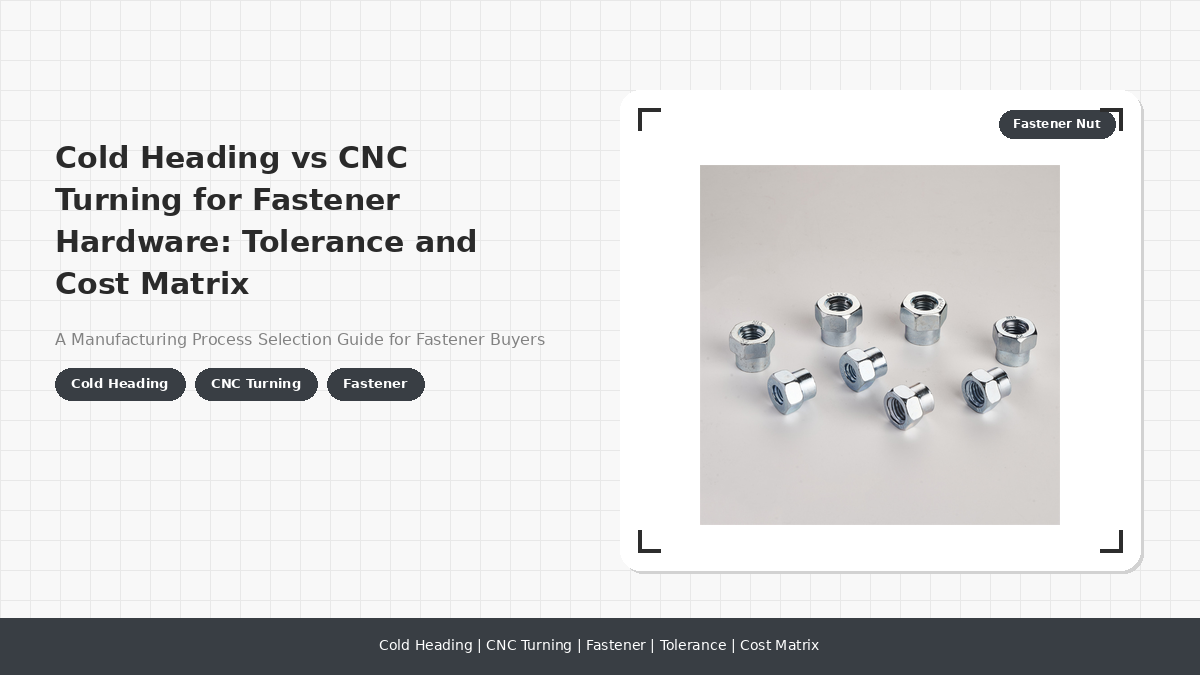
- Cold heading beats CNC turning for symmetric, high-volume parts (flange nuts, pressure plates, hex bolts), while CNC turning wins for asymmetric or low-volume parts.
- Typical MOQ is 5,000 pieces per part number for cold-headed components and 500 pieces for CNC-turned parts.
- Lead time from drawing to first article averages 20 to 30 working days for cold heading and 10 to 18 working days for CNC turning.
- Protect IP with NDA or NNN agreement, tooling-ownership clauses, and a signed quality agreement before tooling payment.
- Use a three-stage qualification process: paper audit, sample run, and pilot production of 500 to 1,000 pieces before committing to the full schedule.
In this guide, I walk through the framework we use with our own OEM clients at Guling Hardware, and I share the data points we have collected across our customer base so you can benchmark your own sourcing decisions. This is the article I wish a brand owner had handed me on day one of running our export business, because the wrong supplier choice will quietly drain margin and reputation for years.
What Does an OEM Brand Owner Actually Buy When Sourcing Power Tool Components?
An OEM brand owner is not buying a part; you are buying a five-year supply relationship that includes quality, capacity, IP custody, and the willingness to keep producing a slow-mover when volume dips. That distinction reframes every sourcing conversation, because it shifts the evaluation from “price per piece” to “total cost of ownership across the product life cycle.”
In the precision-forged power tool accessory segment, the components most often sourced on an OEM basis fall into a small set of families:
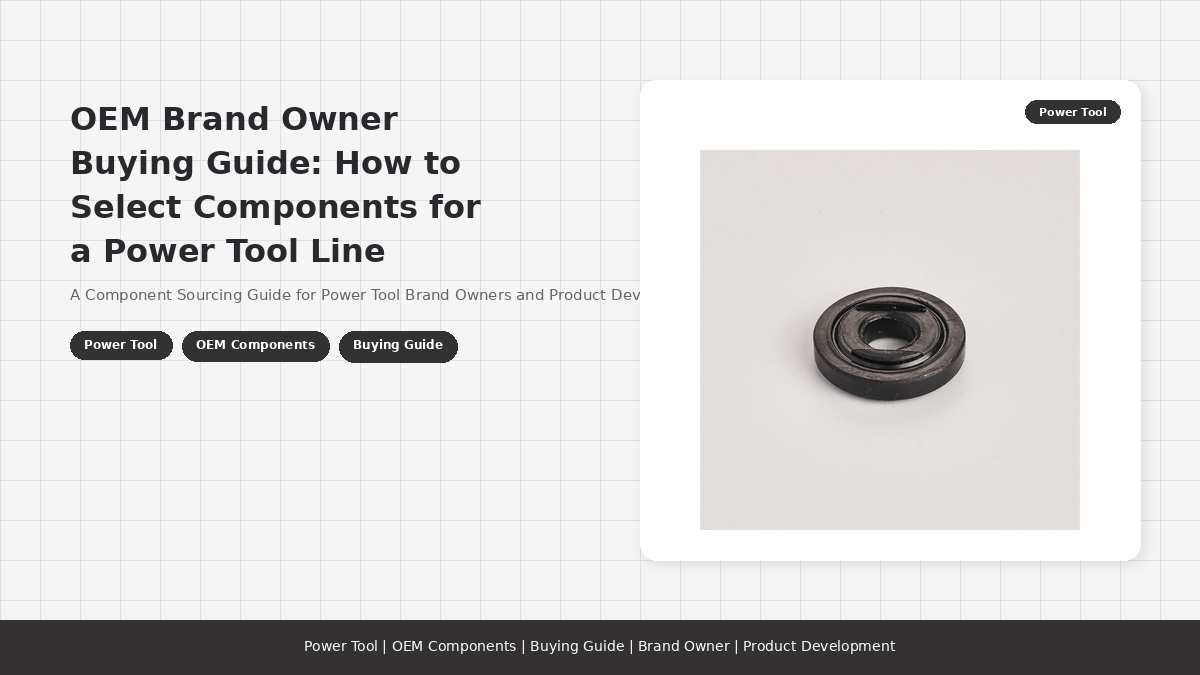
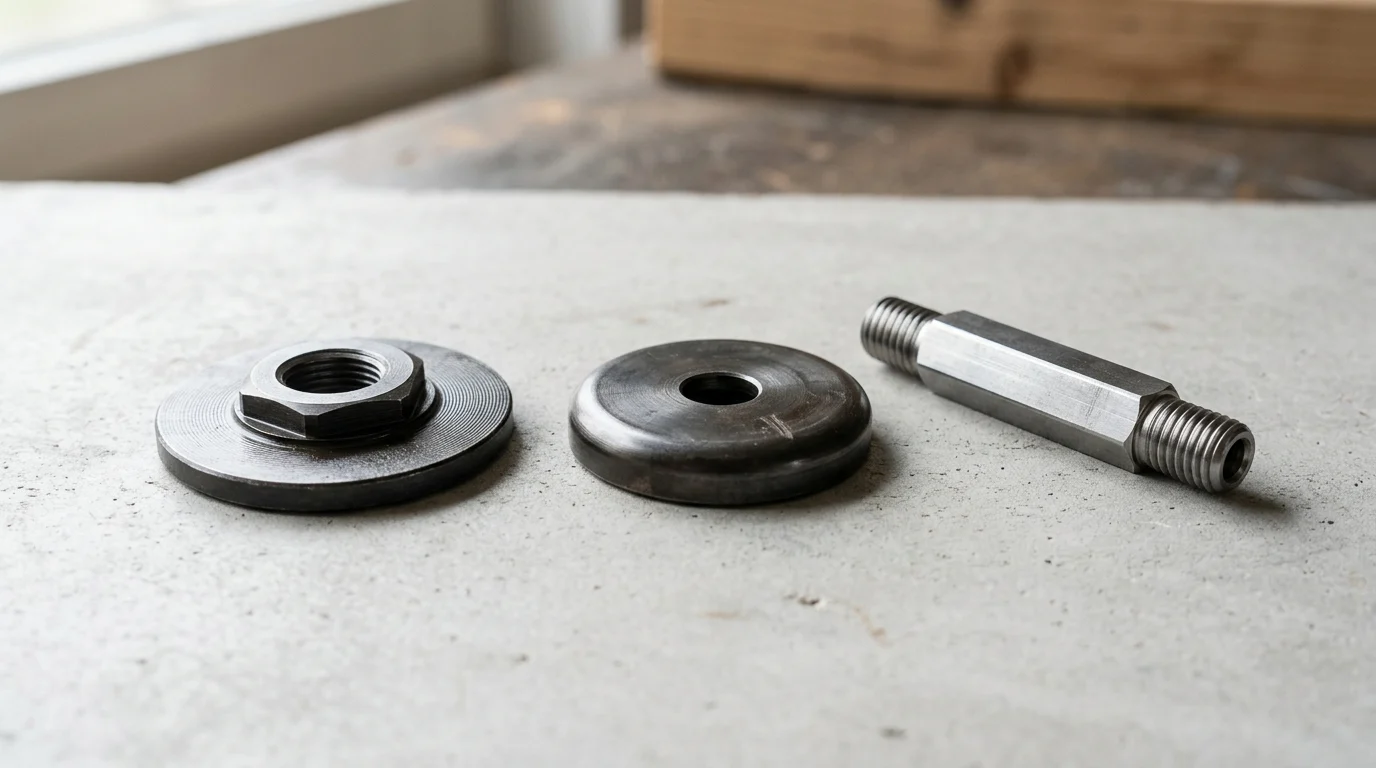
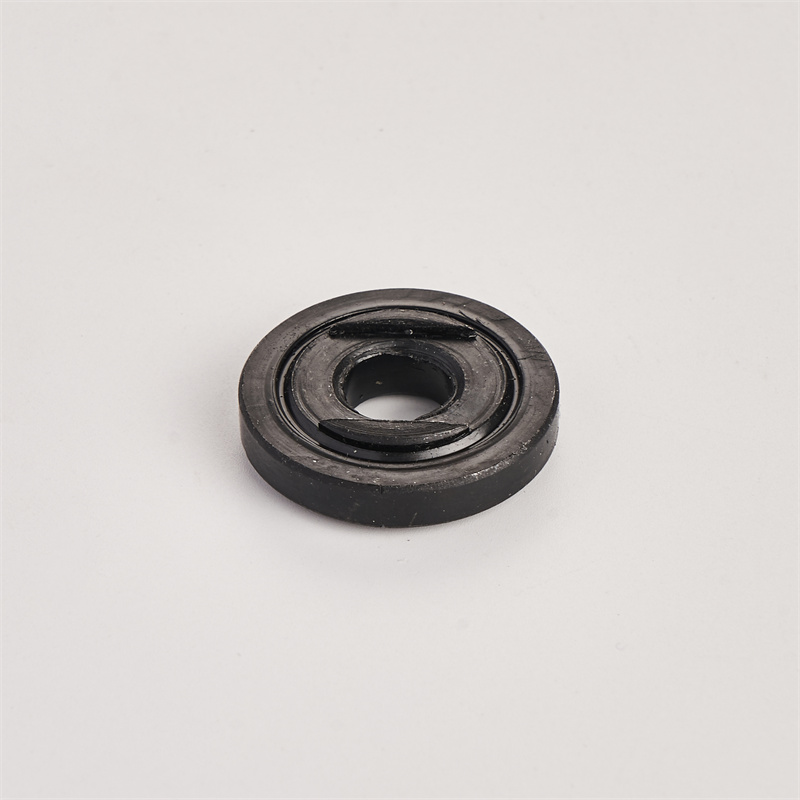
- Angle grinder pressure plates (upper and lower), including the cutting-disc pressure plate variant, which secures a disc to the spindle under rotational load.
- Conversion joints and extension rods, including M14, M10, and 5/8-11 thread adapters that connect drills and grinders to non-native accessories.
- Flange kits consisting of inner flanges, outer flanges, and lock nuts that clamp abrasive discs and wire brushes.
- Wire cup brush nuts and lock rings that hold abrasive brushes on rotary tools.
- Hydraulic fittings and pipe brush assemblies, which cross over from the power-tool ecosystem into adjacent industrial applications.
Within each family, dozens of part numbers are possible, and a typical mid-size brand owner runs an SKU portfolio of 40 to 120 part numbers at any given time. Because each part number has its own die set, its own PPAP file, and its own logistics lane, the supplier’s ability to manage complexity quietly determines whether your launch ships on time.
How Should an OEM Brand Owner Classify Components Before Sourcing?
The fastest way to fail at component sourcing is to treat every part with the same urgency and the same process, because the precision forged flange nut that runs at 12,000 rpm does not deserve the same evaluation as a plastic knob that costs fractions of a cent. Classify every component into one of three tiers before you write a single RFQ, because each tier triggers a different supplier qualification depth.
| Component Tier | Failure Consequence | Typical Examples | Qualification Depth |
|---|---|---|---|
| Tier 1: Safety-critical | Risk of personal injury, tool damage, or regulatory recall | Pressure plates, lock nuts, spindle adapters, flange kits | Full PPAP, torque test, hardness test, dynamic balance verification |
| Tier 2: Functional | Tool works but performance degrades (vibration, runout, premature wear) | Conversion joints, extension rods, brush nuts | Sample approval, dimensional report, surface treatment validation |
| Tier 3: Cosmetic / accessory | Visible defect, ergonomic complaint, packaging issue | Knobs, decorative caps, accessory packaging | Visual inspection, dimensional spot check |
This classification is not academic; because tier-1 parts deserve a full PPAP run with torque-to-failure testing, while tier-3 parts can be qualified on a sample box, your sourcing timeline and engineering cost will vary by an order of magnitude depending on where each part sits. We recommend writing the tier designation into your engineering drawing header, because that single line of metadata protects the supplier relationship when a salesperson tries to substitute a cheaper process for a safety-critical part.
What Questions Should You Ask a Potential OEM Power Tool Component Supplier?
When we evaluate new suppliers on behalf of our own clients, we use a five-question filter that has caught more than one bad fit. The reason these questions work is because the answers reveal whether the supplier is structured for one-off export orders or for sustained brand-owner partnership.
- Who owns the tooling? If the answer is “we do, until you buy X pieces,” walk away. Tooling should be contractually yours from day one, with the dies either held in your custody or stored in a documented location you can audit.
- Can I see a first-article inspection report in your format? A serious supplier ships FAIs with every new part number, including CMM readings, hardness values, and surface treatment evidence. If they cannot produce one, the part has not been made before in a controlled way.
- What is your capacity utilization today? A supplier running at 95% capacity cannot absorb your growth; a supplier running at 40% may lack the discipline to ship on time. The sweet spot for an OEM brand owner is 60% to 80% utilization with documented capacity expansion plans.
- Where do your raw materials come from? For steel, you want traceability to a mill with material certificates to EN 10204 3.1. For surface treatment, you want the plating house named and auditable.
- Who signs your quality agreement? If the answer is “our sales manager,” the quality system is not embedded. You want a signature from the plant manager or quality director.
Cold Heading vs CNC Turning: Which Process Wins for OEM Power Tool Components?
For OEM brand owners, the most important process decision is whether a part should be cold-headed or CNC-turned, because the two processes have fundamentally different cost curves, mechanical properties, and tooling economics. The choice is not about which process is better; it is about which process fits the geometry, the volume, and the performance target of the specific part.
Cold heading deforms a metal slug inside a closed die at room temperature, producing a part with continuous grain flow that follows the part geometry. Because the grain flow is uninterrupted, cold-headed parts typically achieve 20% to 30% higher tensile strength than the same part machined from bar stock, which is why critical fasteners in automotive and aerospace use cold heading almost exclusively. According to ISO 16232:2018 cold heading of fasteners and similar components establishes the cleanliness and process-control framework that automotive and industrial buyers rely on, and ASTM F568M sets the corresponding mechanical-property classes for metric carbon-steel bolts produced by this process. CNC turning removes material from a bar or billet, producing parts with a cut grain structure that is strong but isotropic.
| Dimension | Cold Heading | CNC Turning |
|---|---|---|
| Best-fit geometry | Symmetric, axial, heads, flanges, hex bolts | Asymmetric, large diameter, threaded shafts, low-volume specials |
| Tensile strength vs. machined equivalent | Approximately 20–30% higher due to grain flow | Baseline (matches bar stock rating) |
| Cycle time per part | Typically 2 to 8 seconds | Typically 30 seconds to several minutes |
| Tooling cost | Higher upfront (custom die set) | Lower upfront (standard tooling) |
| Per-piece cost at 10,000 units | Low | Mid to high |
| Per-piece cost at 100,000 units | Lowest | Still higher than cold heading |
| Material utilization | Near-net shape, minimal scrap | Significant chip waste (often 50%+ of bar) |
| Tolerance capability | Typically ISO 2768-m on critical features | Tighter on machined dimensions (down to +/- 0.02 mm achievable) |
In our own production, cold heading handles roughly 70% of our OEM angle grinder accessories by part count, including the upper and lower pressure plates, flange nuts, and brush nuts that define the safety-critical tier. Because the per-piece cost gap widens as volume grows, brand owners launching a long-life SKU almost always save money by routing the part to cold heading once the volume crosses roughly 30,000 units per year. Below that threshold, CNC turning protects tooling investment and allows geometry changes without scrapping a die set.
What Does a Realistic OEM Lead Time Look Like From Drawing to First Article?
Brand owners are routinely burned by optimistic lead-time quotes, because the quote usually reflects the factory’s production calendar and ignores the time lost to drawing revision, die tryout, and first-article inspection rework. Because the typical delay in OEM power tool sourcing is not in production but in the qualification loop, the right planning horizon is 25 to 35 working days end-to-end for a cold-headed part.
Here is a realistic timeline we share with new OEM clients during the kickoff call:
- Days 1 to 5 — Drawing review and DFM feedback. We review tolerances, radii, draft angles, and surface treatment notes, and we send back a marked-up PDF within five working days.
- Days 5 to 8 — Quotation and tooling plan. Once the drawing is approved, we lock the piece price and the tooling cost, and we share a tooling payment schedule.
- Days 8 to 22 — Die manufacturing and tryout. Custom dies are cut and tryout samples are produced. For complex parts this stage can stretch to 25 days; for simple flange nuts it can compress to 10 days.
- Days 22 to 28 — First article inspection and customer approval. We submit an FAI report with CMM data, hardness, and surface treatment evidence, and we wait for written approval before running production.
- Days 28 to 45 — Production ramp and shipment. Production runs in batches sized to your forecast, with shipment by sea or air depending on your inventory plan.
Brand owners who plan their launch calendar against this timeline rarely miss dates. Because tooling tryout is the single biggest source of delay, we recommend approving the drawing quickly and freezing the geometry; mid-stream design changes after die tryout typically cost two to three weeks of lost time.
How Do You Calculate Total Cost of Ownership for an OEM Component?
The cheapest quote on a purchase order is rarely the cheapest component over its life, because a supplier who quotes aggressively on piece price often recovers margin by skimping on inspection, surface treatment, or on-time delivery, and the brand owner absorbs those costs as warranty claims, inbound inspection labor, and stock-out expediting fees. Total cost of ownership (TCO) is the framework that surfaces those hidden costs.
| TCO Component | Typical Range as Share of Piece Price | What to Track |
|---|---|---|
| Piece price (FOB) | Baseline 100% | Per-unit cost on each PO |
| Tooling amortization | Low single-digit % of piece price over typical batch | Total die cost divided by expected batch volume |
| Inbound freight and duties | Mid single-digit to low double-digit % | Freight quote + customs duty + brokerage |
| Inbound inspection cost | Low single-digit % | Labor hours per receiving batch |
| Warranty reserve | Low to mid single-digit % | Historical claim rate x average claim value |
| Stockout / expediting cost | Variable, can exceed 10% during disruption | Premium freight + lost-sale opportunity cost |
Across our own OEM client base, we have observed that suppliers with a mid-single-digit-percent higher piece price but a sub-0.5% warranty claim rate typically deliver a lower five-year TCO than the lowest-quote supplier with a 2% to 3% claim rate. Because warranty cost compounds with brand reputation damage, the true cost of a cheap part is rarely visible on the purchase order.
How Should an OEM Brand Owner Protect Intellectual Property?
IP protection is the single most under-discussed topic in OEM sourcing, and the omission costs brand owners money every year. Because a forged die set is a physical copy of your design, the supplier who makes your part holds the means to make that part for anyone else, which is why tooling custody is the core of OEM IP strategy.
- Signed NDA or NNN agreement before any drawing is shared. NNN (Non-disclosure, Non-use, Non-circumvention) is the standard agreement for China-based OEM work because it adds non-use and non-circumvention clauses that a generic NDA lacks.
- Tooling-ownership clause in the purchase agreement. The contract should name your company as the legal owner of the dies from the moment of payment, with a clause requiring written consent before any third-party production.
- Documented tooling custody. The dies should be stored in a designated, auditable location, with an annual tooling inventory report shared with your team.
Brand owners who skip the NDA and ship drawings anyway often discover their “custom” part appearing on a competitor’s catalog within 12 months. Because the cost of a properly drafted NNN agreement is trivial compared to the cost of a leaked design, this is one of the few areas where the cheapest option is also the wrong option. For cross-border OEM work, the standard reference is the WIPO guide on protecting trade secrets and confidential business information, which lays out the contractual and physical-custody steps an OEM brand owner should require from any manufacturing partner.
Which Certifications Matter Most for OEM Power Tool Components?
Certification requirements vary by destination market, and misaligning on certifications is one of the most common reasons OEM shipments get held at customs. Because the cost of a held shipment is rarely just the freight, brand owners should align certifications with the destination market before tooling starts, not after first article arrives.
- North America (US and Canada): ISO 9001 quality system, RoHS compliance for any plated or coated part, REACH SVHC declaration for substances of very high concern, and material certificates to EN 10204 3.1. CSA or UL marks are typically required on the assembled tool, not the individual component.
- European Union: ISO 9001, RoHS, REACH, and CE marking on the assembled tool. Conflict mineral declarations (3TG) are commonly requested by EU distributors.
- United Kingdom: UKCA marking has replaced CE for the GB market; the technical requirements are aligned with EU CE.
- Australia and New Zealand: RCM mark is required for the assembled tool; component-level certification is less standardized.
- Middle East (GCC): G-mark or equivalent conformity certificates are required for the assembled tool in Saudi Arabia, the UAE, and several other GCC states.
Material certificates to EN 10204 3.1 are the universal baseline because they document the chemistry and mechanical properties of the steel lot, and large distributors will not accept a shipment without them. Per EN 10204 itself, the 3.1 certificate is issued by the mill with independent inspection, which is why it carries weight at customs and at the buyer's incoming-quality department. RoHS substance limits for any plated or coated component are governed by the consolidated EU Directive 2011/65/EU (RoHS 2), and REACH SVHC reporting obligations are defined in the consolidated EU Regulation (EC) No 1907/2006 (REACH). Because certification rework mid-production costs weeks of delay, we recommend listing every required certificate in the RFQ so the supplier confirms scope before tooling starts.
How Do You Build a Five-Year Sourcing Roadmap for a Power Tool Line?
Brand owners who treat sourcing as a continuous function rather than a project build a structural advantage, because the cost of qualifying a new supplier is amortized only when the relationship lasts long enough to recover the qualification investment. A typical OEM qualification cycle costs the brand owner 80 to 200 hours of engineering and quality time, which means a supplier who lasts two years has barely paid back the qualification cost before the relationship ends.
Our recommended roadmap looks like this:
- Year 1 — Qualify two suppliers per critical part. Single-sourcing a safety-critical part is a concentration risk; dual-sourcing protects against disruption and gives you negotiation leverage.
- Year 2 — Consolidate to the stronger supplier for volume. Use the dual-source period to compare quality, delivery, and responsiveness, then shift 70% to 80% of volume to the stronger partner.
- Year 3 — Co-develop next-generation parts. Bring the supplier into your product roadmap early so they can invest in process improvements alongside you.
- Year 4 — Renew contracts and revisit IP. Refresh NDAs, audit tooling custody, and renegotiate pricing based on the volume curve you have actually shipped.
- Year 5 — Decide whether to extend or rebid. By year five, you have enough data on quality and delivery to make a clean decision rather than an emotional one.
Because the cheapest year-five supplier is rarely the cheapest year-one supplier, the discipline of multi-year sourcing planning compounds into a real cost advantage, and it is one of the quietest sources of margin improvement in a mature power tool brand.
Talk With Our OEM Engineering Team
If you are evaluating suppliers for a new power tool line, our team can review your drawings and provide a DFM-marked PDF and a fixed-price quotation within five working days.
Request a Quote See Our OEM Workflow Browse OEM Angle Grinder Accessories
Frequently Asked Questions
What should an OEM brand owner verify before signing a power tool component supplier?
Verify three layers: a sample-to-PPAP qualification run with a dimensional report and torque-load test results, an on-site or video audit of forging and CNC capacity, and a signed IP and tooling-ownership agreement before tooling payment. We recommend trialing a 500 to 1,000 piece pilot run before committing to a production schedule.
How does cold heading compare to CNC turning for power tool accessory components?
Cold heading delivers grain-flow continuity and tensile strength that CNC turning cannot match, with cycle times measured in seconds rather than minutes. For symmetric high-volume parts such as flange nuts, pressure plates, and hex bolts, cold heading wins on both mechanical performance and unit cost. CNC turning remains the right choice for low-volume, asymmetric, or large-diameter parts where tooling cost is prohibitive.
What MOQ is realistic for a custom OEM power tool component?
For cold-headed components, MOQ typically begins at 5,000 pieces per part number because custom die sets represent a fixed cost. For CNC-turned components, MOQ can start as low as 500 pieces. Pilot runs of 200 to 500 pieces are commonly used for qualification testing before committing to a production batch.
How can brand owners protect their proprietary component designs?
Three measures are essential: a signed NDA before any drawing is shared, tooling-ownership clauses that name the brand owner as legal owner of dies and fixtures, and geography-aware tooling custody where dies stay in a facility you trust. We sign NDA, NNN, and tooling-ownership agreements as standard practice for international OEM clients.
What is the typical lead time from drawing to first article for OEM power tool parts?
For cold-headed components, expect 20 to 30 working days from approved drawing to first article, driven primarily by die manufacturing. For CNC-turned components, expect 10 to 18 working days. Full production ramp-up typically adds another 15 to 25 working days depending on batch size and surface treatment.
Which certifications matter most for OEM power tool components sold in North America and the EU?
For North America, look for ISO 9001 quality systems, RoHS compliance for any plated or coated part, and REACH SVHC declarations. For the EU, the same ISO 9001 plus RoHS and REACH apply, and CE marking may be required for the assembled tool. Material certificates to EN 10204 3.1 are typically requested by distributors and large retailers.
How do you calculate total cost of ownership when sourcing OEM components?
TCO includes unit price, inbound freight, customs duties, tooling amortization, inspection cost, warranty reserve, and the cost of supply disruption. A supplier with a slightly higher piece price but lower warranty claims and on-time delivery often delivers a lower five-year TCO than the cheapest quote on a purchase-order basis.