




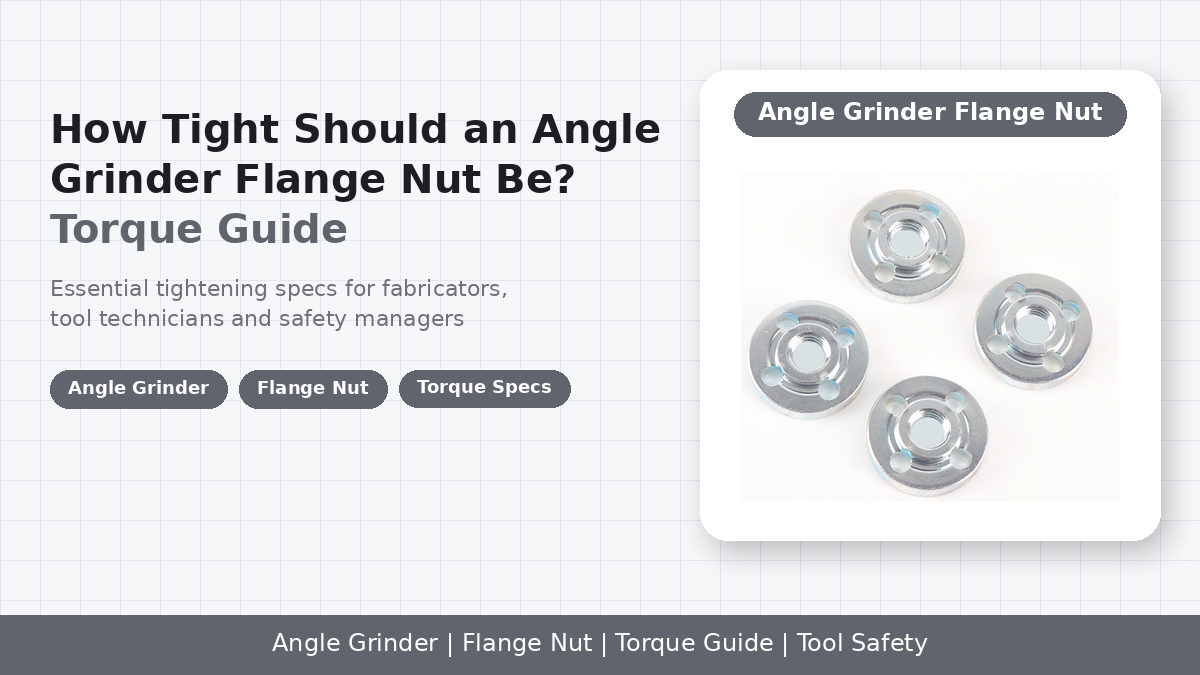
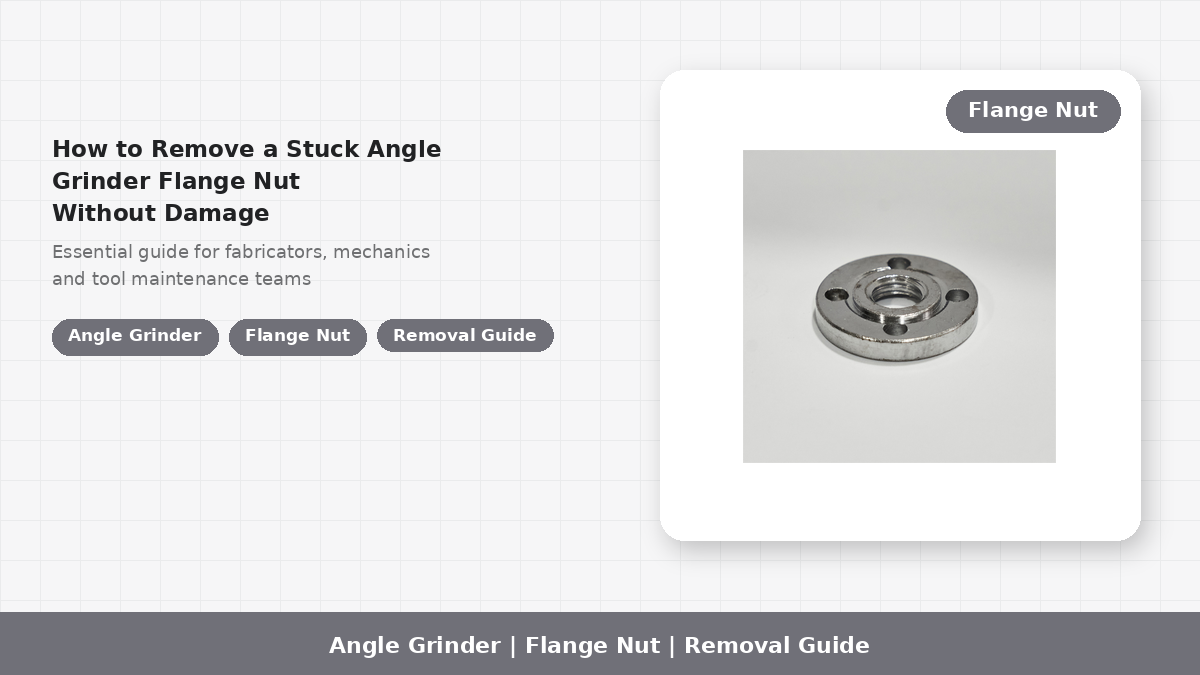
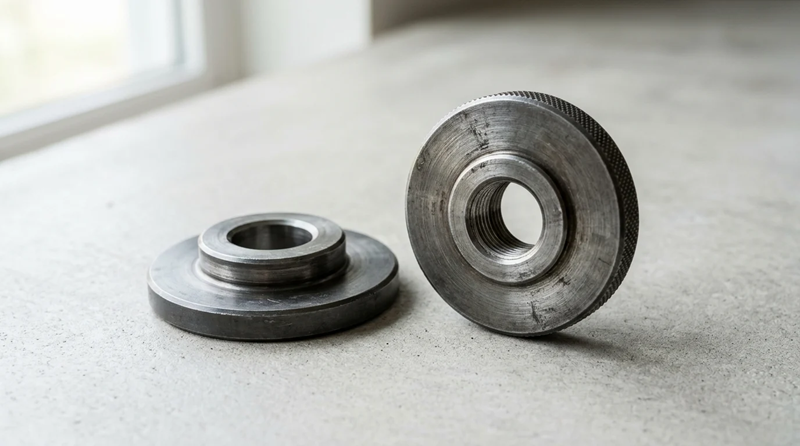
A locking angle grinder flange nut is not a torque fastener, so the question has a different answer than it does for a bolt. Tighten it firmly with the correct pin spanner until the wheel stops rotating freely, then confirm there is no wobble. Our published flange specification holds aperture tolerance at plus or minus 0.05 mm, thread grade at 6H, parallelism at or below 0.03 mm, hardness at HRC 45 to 50 and salt spray at 48 hours, and those numbers decide whether the nut stays tight.
Quick answer
- There is no torque figure to hit. A locking flange nut clamps through the pin holes, not through thread friction, so tighten firmly with a matching pin spanner until the wheel stops turning freely, then check for runout.
- Never use an open ended wrench. It galls the thread, deforms the nut and leaves swarf in the joint, turning a five minute removal into a replacement.
- A loose flange is usually a product defect, not operator error. Our published diagnosis attributes it to an oversized aperture, a poor thread fit, or poor flatness and parallelism, and only one of the three involves the nut.
- Three checks diagnose it in thirty seconds. Wiggle the flange on the spindle for play above 0.1 mm, spin the wheel by hand for wobble, and mark alignment lines on nut and spindle to confirm the thread has not self-locked loose in service.
- For a buyer, the specification is the torque. A distributor case study we published shows a 14,000 US dollar unit price saving turning into 48,000 US dollars in warranty and account loss cost, because the cheap flange was specified at HRC 38 to 42 with 24 hour salt spray instead of HRC 45 to 50 with 48 hours.
I run Yuyao Guling Hardware, a precision forging and metal forming plant in Yuyao, Ningbo, where we make upper and lower pressure plates, locking nuts and conversion parts for 100, 115, 125, 150, 180 and 230 mm grinders. This guide is written around our thickened four-hole upper pressing plate and our published loose flange diagnosis.
Why a Flange Nut Is Not a Torque Fastener
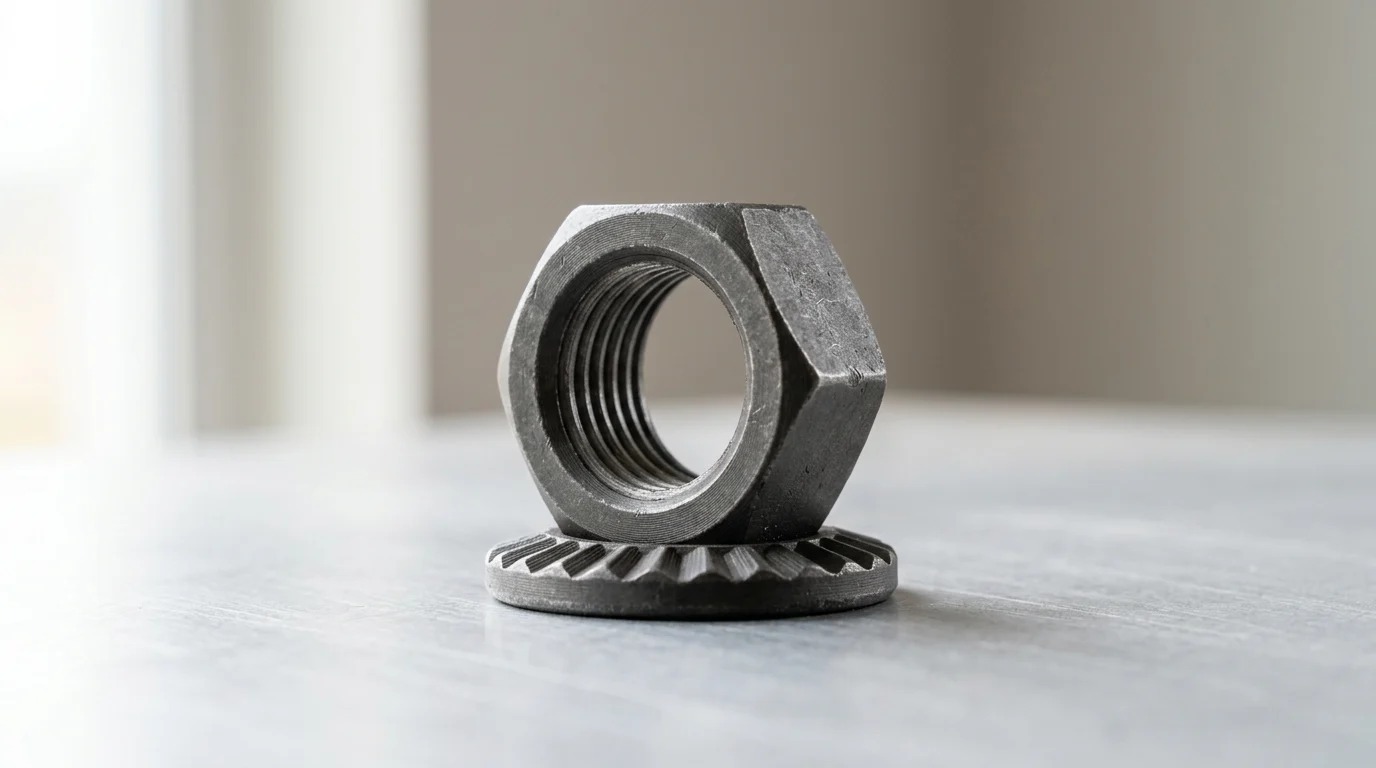
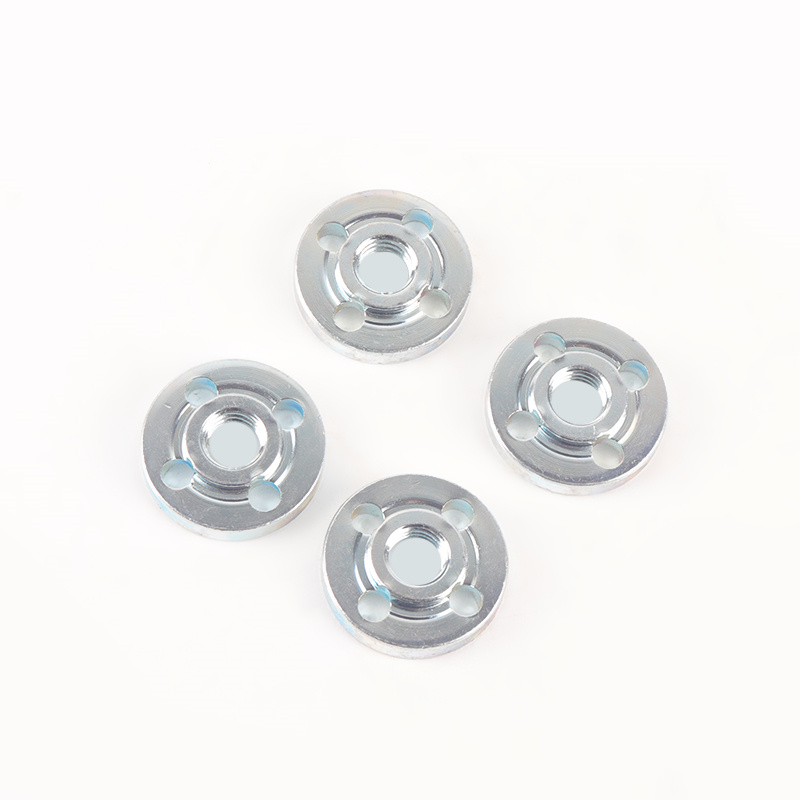
The reason there is no torque figure is mechanical, and most people approach a flange nut with the expectations they have for a bolt. A locking flange nut clamps the wheel through the pin spanner bearing on the pin holes, not through friction between the nut thread and the spindle thread. The thread holds the nut on during service; the pin holes apply the clamping load. Tighten it with an open ended wrench instead and the load goes into the nut body, chewing the thread, deforming the nut and burying swarf in the joint.
The Three Checks That Diagnose a Loose Flange in Thirty Seconds
Before you replace anything, run these three checks, because most reported loose flanges turn out not to be a nut problem at all. The three causes are an oversized aperture, poor thread fit, and poor flatness or parallelism, and none of the three is the nut itself.
| Cause | What happens | Consequence |
|---|---|---|
| Oversized aperture (most common) | Centre hole diameter greater than the spindle diameter, gap above 0.1 mm | Flange cannot centre; eccentric rotation loosens the nut |
| Poor thread fit | Low thread precision or a mismatch with the spindle threads | Insufficient clamping force; vibration loosens it quickly |
| Poor flatness or parallelism | Top and bottom surfaces not parallel; uneven contact with the wheel | Uneven stress leads to partial loosening |
Now the three checks. The visual test: put the flange on the spindle and wiggle it; if you feel obvious play above 0.1 mm, the aperture is too large. The tightening test: after normal tightening, spin the wheel by hand; if it wobbles, the concentricity or dynamic balance is poor. The marking test: draw alignment lines on the nut and spindle, use the grinder for a few minutes, then check whether the lines still align.
The Tightening Procedure, Step by Step
The order below is the one we use on the bench, and each step exists because skipping it produces a specific failure.
How to tighten a flange nut correctly
- Confirm the thread and the disc type first. M14 x 2 covers most 115, 125, 180 and 230 mm grinders, M10 covers 100 mm machines common in Asian and South American markets, and 5/8 inch - 11 is common in North America. A depressed centre Type 27 cutting wheel sits about 6 mm offset from the spindle while a flat Type 1 grinding wheel sits flat.
- Seat the disc with the label facing the guard. A wheel mounted the wrong way round, a disc with a bent rim, or a wheel seated against the guard will wedge between the two flanges as soon as you tighten, and the nut then carries the load of that jam and locks up as if seized.
- Choose the matching pin spanner. Two hole locking nuts take a two pin spanner, three hole nuts a three pin spanner, and the four hole locking nuts common on M14 grinders take a four pin spanner. Pin diameters commonly fall between 4 mm and 5 mm, so measure the hole with a caliper.
- Tighten firmly by feel with the pin spanner. Turn until the wheel stops rotating freely. Do not lean on the spindle lock while the wheel is loaded, and do not use an open ended wrench.
- Verify with the three checks. Wiggle for play, spin by hand for wobble, and mark the alignment lines before first use.
- Replace rather than reuse a damaged flange. Reuse it if the clamping face is flat, the pin holes are round rather than oval, the centre boss stands proud of the face, and the thread engages cleanly with no galling. Replace it if the face is dented, the holes are rounded, the thread is chewed, or the flange has been hammered.
What Actually Keeps a Nut Tight: The Flange Specification
For a buyer, you do not control that with a torque wrench, you control it with the flange specification and the incoming inspection. These are the six parameters our published factory standard holds, and each exists because its absence produces a specific failure mode: aperture tolerance of plus or minus 0.05 mm, verified on 100 percent by CNC machining plus AI vision inspection at 0.01 mm accuracy; thread accuracy at 6H grade, verified by 100 percent go and no-go gauge testing; concentricity, confirmed on a dynamic balance tester; flatness and parallelism at or below 0.03 mm, measured by CMM; hardness at HRC 45 to 50, verified by batch sampling; and anti-rust performance of 48 hour salt spray with no red rust, also verified by batch sampling. Every flange we ship is AI vision inspected and dynamic balance tested before shipment, which is how the first two causes get caught before the part leaves the factory rather than after a disc comes off in service.
And this is a safety specification rather than a workshop preference, because a flange nut that is not holding the wheel is the difference between a grinding wheel and a projectile. According to 29 CFR 1910.212, the general requirements for all machines, the point of operation of machines whose operation exposes an employee to injury shall be guarded, and in the absence of applicable specific standards shall be so designed and constructed as to prevent the operator from having any part of the body in the danger zone during the operating cycle. Portable power tools are named in the list of machines which usually require point of operation guarding, and a disc that comes loose because the flange aperture was 0.15 mm oversized is a guarding failure that started at the incoming inspection bench.
And the money argument, which is what a purchasing manager needs. Our published distributor case study describes a midwestern US distributor with a 180,000 US dollar annual budget for flanges and arbors across three private label programmes. The first supplier quoted HRC 38 to 42 with 24 hour salt spray at the lowest unit price, the second HRC 40 to 44 with 48 hour NSS at a 12 percent premium, and the third HRC 35 to 45 with 96 hour NSS at a 25 percent premium. The buyer defaulted to the first, and fourteen months later two retail accounts had filed warranty claims on brittle fracture and a third had switched to a competitor after salt spray corrosion appeared at the 90 day outdoor storage mark. The 14,000 US dollars saved on unit price turned into 48,000 US dollars in warranty and account loss cost.
Conclusion: Specify the Flange, Not the Torque
The honest answer to how tight should the flange nut be is that the number does not exist, and the reason is the same reason the part fails. A locking flange nut clamps through geometry and holds through thread, so it has no torque specification, and a nut that has to be torqued to stay on is already describing a fault.
My own view: the buyers who get this right stop asking suppliers for a torque value and start asking for the six inspection parameters above, because those are the numbers that determine whether the nut stays tight for the life of the machine. We publish them because we build to them. If you are qualifying a flange supplier, send us the grinder platforms you sell into and the disc types your customers run, and we will return the measured dimensions, thread and finish for every pressure plate we publish, with the inspection method attached to each line.
Frequently Asked Questions About Angle Grinder Flange Nut Torque
How tight should an angle grinder flange nut be?
A locking flange nut is not a torque fastener, so there is no torque figure to hit. Tighten it firmly with the correct pin spanner until the wheel stops rotating freely, then confirm there is no wobble. Because the pin holes are the only features designed to transfer load into the nut, an open ended wrench galls the thread and leaves swarf in the joint, turning a removal into a replacement.
Can I use an open ended wrench on an angle grinder flange nut?
No. The pin holes are the only features designed to transfer load into a locking nut, and a wrench will gall the thread, deform the nut and leave swarf in the joint. Use a pin spanner matching the hole pattern, two pin, three pin or four pin, and check the pins are not loose in their holes.
Why does my angle grinder flange nut keep loosening?
Three causes account for most of it, and only one is the nut. An oversized aperture with a gap above 0.1 mm means the flange cannot centre and eccentric rotation loosens it. Poor thread fit gives insufficient clamping force so vibration loosens it quickly. Poor flatness or parallelism gives uneven contact with the wheel. Diagnose with the wiggle, hand-spin and marking tests before replacing anything.
Is a quick release flange nut better than a standard locking nut?
It depends on the duty and it is not a drop-in substitute. A quick release nut needs no tool and saves time on repeated disc changes, which pays off for contractors doing numerous changes per shift. But it is thicker, needs a minimum exposed spindle length and may interfere with certain guards, it may not satisfy the torque requirements certain grinder OEMs specify, and because it relies on internal springs, abrasive dust can jam the mechanism. For continuous heavy grinding, standard nuts and solid pressure plates remain stronger.
How do I know whether my grinder takes M10 or M14?
Look at the old nut or the old backing flange and read the thread, or check the grinder manual and nameplate. Most 115, 125, 180 and 230 mm grinders use M14 x 2, smaller and specialist machines often use M10, and North American machines commonly use 5/8 inch - 11. The thread is the one dimension you cannot work around, because an M14 nut will not pass on an M10 spindle.
What should a distributor put in a flange nut purchase order?
Six clauses. Aperture tolerance at plus or minus 0.05 mm verified on 100 percent with AI vision at 0.01 mm accuracy. Thread accuracy at 6H grade verified by 100 percent go and no-go gauge testing. Concentricity confirmed on a dynamic balance tester. Flatness and parallelism at or below 0.03 mm by CMM. Hardness at HRC 45 to 50 by batch sampling. Anti-rust performance at 48 hours salt spray with no red rust, also by batch sampling. The last two are where the published distributor case study shows the money is lost, when a 14,000 US dollar unit price saving became 48,000 US dollars in warranty and account loss cost.